Wednesday, May 9, 2012

Local Disaster Mental Health Volunteers Recognized by Mental Health Assoc. of Southeast FL


By Nelda Figueiredo

Ron and Marti Ellis, long time Red Crossers, have had an incredible impact on the South Florida community through their tireless volunteer work with the organization.

The Ellises have always wanted to make a difference in the community and felt the need to act and join the Red Cross in the wake of the terrorist attacks of September 11, 2001.

“We wanted to step up and to be a part of something; 9-11 gave us that extra push to begin,” said Ron and Marti, who work throughout the South Florida Region and are a fixture in the Broward office.

Ron and Marti have since played a pivotal role on the Disaster Mental Health Team. The duties of American Red Cross Disaster Mental Health Workers (DMHW) include easing the emotional distress of people who have survived a disaster. Over the years, Ron and Marti also have trained other volunteers to be disaster mental health workers.

The hard work of these two devoted Red Crossers does not go unnoticed.

Ron and Marti are due to be recognized on May 15 by The Mental Health Association of Southeast Florida at its 17th Annual EPIC luncheon and awards ceremony for Exceptional People Impacting the Community (EPIC).

The EPIC Awards are given to those who have devoted their time to the public good and have contributed to the behavioral health of people within their community. The EPIC Award has honored public officials, advocates, journalists, celebrities and service providers for the past 17 years. 

Ron and Marti have developed many teams and have trained them to help families cope with the stress and anxiety that occurs after being affected by a disaster. “It is a group effort; Ron and I could not do this all on our own,” Marti said.

The couple work alongside caring volunteers who assist individuals and their families in the most difficult of times.

“They are extremely valuable, and they are true leaders,” said Sylvia Taylor, who oversees Direct Services in South Florida, the department Ron and Marti report to.

“They have developed and brought focus to the team,” she said of the dynamic duo. “They keep everyone engaged, which at times can be a challenge.”

The couple’s passion also sees them continually sharing their Red Cross stories with the community in an effort to encourage others to sign up and give back.

“It feels good to volunteer and it feels like we keep getting much more than we give,” Ron said. “It shows humanity and compassion in the making.”

Young SFL Red Crosser Earns President's Volunteer Service Award

Congratulations are in order for one of our youngest and most active volunteers, Keegan Rose!

Keegan, a 6th-grader at Herbert A. Ammons Middle School, in West Kendall, has accumulated so many volunteer hours with the American Red Cross South Florida Region that The Prudential Spirit of Community Awards recently recognized him with the President’s Volunteer Service Award, presented on behalf of President Barack Obama.

The award recognizes young people who have volunteered a significant amount of time to serve their communities and their country.

Keegan, 11, began volunteering with the Red Cross in February 2011 and has served in a variety of roles throughout the region, including working as an instructor’s aide and responding to local disaster and house fire scenes.

So far, he has an estimated 200 volunteer hours with the organization.

Keegan’s mother, Steffany Lee, also is a very active local Red Cross volunteer.

Way to go , Keegan!
 

Monday, February 13, 2012

From Red Cross Volunteer to Bride: A Love Story

After 55 years of marriage, Dick and Sara Nooe still appreciate that the
American Red Cross brought them together.

by Barbara Behling, American Red Cross

Monday, February 13, 2012 — U.S. Marine Dick Nooe was shot multiple times in the leg and the face, three days before the end of the Korean War. Blinded by the shots, Dick felt his life—as he knew it—was over.

Evacuated by helicopter to the nearest Mash Unit, he ultimately made his way to the Blind Rehabilitation Ward at the Hines Veterans Administration Hospital in Chicago, Illinois. He remained there from February through July 1954. While there he healed, with the help of one very special American Red Cross volunteer—a Gray Lady named Sara Scotchell.

Sara, a young professional, signed up with several gals in her office to become Red Cross Gray Ladies, named for the grey uniforms the volunteers wore. Gray Ladies read and wrote letters, talked and provided non-medical support to sick, injured and disabled veterans.

Dick and Sara Nooe fell in love more than 50 years ago when she was a Red Cross Gray Lady in a VA Hospital. Photo Credit: Barbara Behling

Every Thursday, Sara’s team, assigned to support the blind unit, would host a social, providing snacks, beverages and music. “We were there to help the veteran’s become more active,” she commented. “Dick was standing in the corner, looking a bit pathetic, so I asked him to dance.”

That dance was the first of many in their 55 years of wedded bliss. “We weren’t supposed to go out with any of them, but we did start to smooch a bit,” she blushes. Dick adds. “The boys told me she was good looking and if we went outside I could see a muffled outline of her face and body. While never truly seeing her, I know she is beautiful.”

After Dick was discharged from the hospital, he returned to Oregon to pursue a Social Work degree. The two kept in touch by letter and an occasional phone call. Sara would tape a love letter on a recording device and send it to him; he would listen to it on a Dictaphone belt. She traveled to Oregon during one summer break. The long-distance engagement was official in 1956. Soon after, Dick earned his graduate degree and they started a family.

Today, the Nooes live in Neenah, Wisconsin. At 80, Dick is still counseling part-time and is still giving back by working with local veterans. A year ago, they returned to Hines Veterans Administration Hospital to visit with other blind veterans. Dick always delivers a message of hope. “Look at us, together we have enjoyed a wonderful life,” he says, “We are blessed with two children and six grandchildren. We love to travel to Europe, Hawaii and across the United States.”

Each summer, they attend their military reunions—even though each year fewer and fewer veterans are there. Sara’s Gray Lady dress and hat have been safely stored through the decades. Her Red Cross volunteer pin is placed in the family keepsake box. It’s right next to Dick’s military ribbons of valor, including the Purple Heart.

Today, Dick and Sara continue to support the American Red Cross across the country and around the globe. “I give in my wife’s honor,” he said. “Just imagine if I had not had this young Red Cross volunteer in my life?”

Thursday, February 2, 2012

Join the Red Cross Team

Want to join the Red Cross Team at the 3nd Annual Tour de Broward Bike-Run-Walk on 2/26/12? Click on http://tourdebroward.kintera.org/ and select Team Red Cross. (There's a registration fee).

There will be family fun for the you and your friends including a Kid Zone, live entertainment, raffles, food and more!

Got questions? Call 954-797-3807

Wednesday, January 25, 2012

Hope in the Shape of a Teddy Bear

Even though the holidays are long gone, this story still resonates for many Red Cross volunteers and staffers.

On December 24th, the person at dispatch received a call regarding a fire at a ranch-style house in Homestead. The house belonged to a small business owner who makes a living selling affordable cars to farm laborers in the area. When the Red Cross Disaster Action Team volunteers arrived they found the home totally destroyed. Only the father was there, the mother and daughter had gone out to run last minute errands before their Christmas dinner and weren't back yet.

In preparation for the holidays they had decorated a big tree with lights and had even installed a life-sized dancing Santa. The fire started when the outlet where everything was plugged in overheated. The father was in the yard mowing his lawn when he heard his dog barking desperately. He turned to see his house on fire and sprung into action. He had just enough time to go inside to retrieve the family dog. For us, at the Red Cross, it is unfortunately a story we have heard before around this time the holiday season.

The DAT leader assessed the damage and because the family has no relatives in the area, gave them a hotel voucher for three nights and a card with money for food and clothes. As the Red Cross volunteer was leaving, he pulled out a teddy bear from his car and gave it to the father to give to his twelve-year-old daughter.

It was at this point that the man started to cry. He thanked the Red Cross volunteer and explained that he was heart broken he had to tell his little girl that she had lost her teddy bear collection in the fire. But thanks to the American Red Cross and its donors, Roberto the volunteer was able to give one little girl who had just lost all her belongings the first teddy bear for her new collection.

Tuesday, January 17, 2012

Red Cross Volunteer Recognized as Unsung Hero

Longtime American Red Cross volunteer Dr. Margaret Blair, of Islamorada, will be recognized at the Unsung Hero Awards on Friday! Dr. Blair has volunteered for the Red Cross in three states, leads our fundraising team in the Keys and in 2010 helped us create the local Clara Barton Society, paying tribute to the Red Cross founder.


The awards luncheon is sponsored by the Community Foundation of the Florida Keys and will be held at the Casa Marina Resort in Key West.

Congratulations to Dr. Blair! We're very lucky to have her.

Tuesday, January 10, 2012

Two Years After Haiti Earthquake, American Red Cross Remains Very Active in Recovery Efforts

Two years after the Haiti earthquake, the American Red Cross continues to help people rebuild their home and lives, with hundreds of millions of dollars committed to the ongoing recovery effort.

In a two-year update, the American Red Cross highlighted its emergency work after the 7.0 earthquake struck Haiti on January 12, 2010, as well as its recovery efforts over the past year.

“People in South Florida and across the country responded to help Haiti, and their donations are making a difference with recovery and rebuilding,” said Sam Tidwell, CEO of the South Florida Red Cross. “The money provided life-saving relief to millions of Haitians after the earthquake and is now being used for longer-term housing, health, safe water and other recovery programs.”

Other highlights of the past year include:
  • Providing clean water and sanitation services to more than 369,000 people
  • Providing health services and hygiene education to more than 2.4 million people
  • Reaching more than 3 million people with cholera treatment and prevention
  • Teaching more than 436,000 people how to better prepare for disasters
  • Providing livelihoods assistance – grants, jobs and other help – to 114,000 people
The American Red Cross received about $486 million in donations following the earthquake, and has spent and signed agreements to spent $330 million on Haiti earthquake relief and recovery efforts in the first two years. The largest portion of spending has gone to food and emergency services, followed by housing, water and sanitation, health, livelihoods, disaster preparedness, and response to the cholera outbreak.

The two-year report on Red Cross relief and recovery efforts in Haiti can be found at www.redcross.org/haiti.


Thursday, January 5, 2012

Burger King Corp. Gifts Red Cross with New Emergency Response Vehicles

Miami, FL (January 5, 2012) — The American Red Cross recently rolled out 10 new emergency response vehicles, generously provided by Burger King Corp. (BKC).
South Florida Red Cross is a grateful recipient of one of these new vehicles, which we call “ERVs.”

A dedication ceremony was held Monday, December 12, at Burger King’s global headquarters, 5505 Blue Lagoon Dr., Miami.

Earlier this year, the restaurant chain collected contributions from its customers over a six-week period in support of the Red Cross. The collected donations were used solely to purchase as many ERVs as possible to serve communities across the country.

“We are very thankful to BKC for their commitment in helping the community in times of disaster,” said Sam Tidwell, CEO, American Red Cross South Florida Region. “These vehicles are essential in disaster relief operations. They provide mobile and stationary feedings, distribution of items, and, if needed, are used to do casework and transfer supplies.”

The 10 new ERVs feature the BURGER KING logo as a way to recognize the company’s generous contribution. The new vehides join a fleet of more than 300 Red Cross emergency vehicles around the country and have already been used in disaster relief operations in Alabama, Indiana, Illinois, Louisiana, Nebraska, Oklahoma, Oregon, Texas and Miami.


Pictured: the ribbon cutting in front of the new ERV, from left: Peter Giamalva- Red Cross Division Vice President of Development; Cesar Gonzalez- Chief of Staff for U. S. Congressman Mario Diaz-Balart; U. S. Congresswoman Ileana Ros Lehtinen; Steve Wiborg- President, Burger King Corp. North America; Glen Helton- Senior Vice President, Burger King Corp.; Sam Tidwell- CEO, American Red Cross, South Florida Region.

Photo credits: Courtesy of Burger King Corp.

Wednesday, January 4, 2012

Red Cross to Celebrate Florence Spottswood Humanitarian of the Year Event

Come join the American Red Cross for its annual Florence Spottswood Humanitarian of the Year Gala.
 February 4, 2012   6:30 pm - 10:00 pm


Justin and Eileen Kawaler


The Florence Spottswood Humanitarian of the Year Award is named in honor of Florence Spottswood, founder of the American Red Cross Chapter in Key West in  1917, whose grandson, Mr. Robert Spottswood, has been a member of the dinner committee since its inception in 1995. The award recognizes outstanding leaders who best exemplify the principles of the American Red Cross: humanity, impartiality, neutrality, independence, voluntary service, unity and universality.

Chaired by the 2011 honorees, Eileen and Justin Kawaler invite you to an evening of fun, food and music. All contirbutions benefit the lifesaving programs of the Red Cross in the Florida Keys.

For reservations and sponsorship opportunities, please contact Betsy Dietz at: 305-292-1145 or betsy_dietz@yahoo.com

Monday, July 11, 2011

South Florida volunteer: Flood waters receed in Minot

Hello!

I'm wrapping up my second week in Minot, ND. The flood waters have receded substantially thanks to the hot weather and the water pumping that the city has been doing.


Flood waters slowly receed in Minot, ND
Minot residents are thankful for the help Red Cross
volunteers have offered
I’ve been working with the damage assessment team and we’ve finished our detailed damage reports. Thankfully, we have been able to create street sheets for almost all of Minot and Burlington, the neighboring city. But it was challenging because water was more than 6 feet high in many places. 

As the water recedes, we are starting to see everything that was hidden under the water. Trees, cars, bridges and houses are all starting to peek through. Slowly, the people of Minot are starting to get back to their normal routine, more people are on the roads and the local university is starting classes again.

However, many people still cannot get back into their houses because the water is still extremely high in some areas. As more time passes, some clients are becoming frustrated, but we are doing our best to keep them comfortable, informed and well cared for.

More than 150 client caseworkers have arrived on site now that the DA team has finished its work. The original plan was to go out in outreach teams and finish client casework activities. However, that plan has been changed to setting up service centers and having clients come to us. It is still a hectic and difficult operation. However, it has been a great learning experience! 

I am attaching some more pictures. You can see a clear water line in most of them to show how the water has gone down.


-Tiffany Hamm
AmeriCorps team member

Friday, July 1, 2011

From disaster springs hope, inspiration

Joining the American Red Cross through the fellowship program this summer has introduced me to a team of hard working people who truly care about the welfare of others. I’ve heard the stories of employees and volunteers taking hours, days, and even weeks of their time to leave their homes and families to help those in need.

Their stories are moving, but I really felt the impact the American Red Cross can have when I joined a team of volunteers as they responded to a disaster here in Miami, Florida.

One of the residents of this North Miami home leads
Red Cross volunteer Cherlynette Evans through his burned
home. Photo by Nick Kulig
I drove to North Miami to accompany a team of three American Red Cross volunteers as they responded to a house fire. I was nervous, not knowing what kind of reaction to expect from the residents at this tragic time in their lives. They had lost everything, with the exception of whatever they could fit into a few suitcases and trash bags. What do you say to comfort them? How can you even pretend to relate to their situation? Luckily, I had the American Red Cross volunteers by my side.

The volunteers were amazing. They brought a glowing attitude with them, showing the victims of the fire that they truly care and want to help. The volunteers have been there before, which clearly helped calm the atmosphere as reality kicked in for the victims. They had just lost nearly everything they owned.

The American Red Cross and the volunteers brought hope to them, somehow putting a smile on their faces in this time of disaster. They now had food to eat and a hotel room to stay in for a few nights while they determine how to move on. At the end of the day, it could have been worse; they could be on the streets with nothing.

This experience was very inspirational and something I will never forget. The American Red Cross and its volunteers came into a tragic situation and provided a family with hope, something they desperately needed as they try to move forward.

-Nick Kulig
American Red Cross MBA fellow

Tuesday, June 28, 2011

South Florida volunteers help flooded North Dakota residents

Writing to you from Minot, ND. I was originally assigned to Bismarck, however, Minot has the most need for our help right now.

Flood waters reach the eaves of this building in Minot, ND

This is the worst flooding that Minot has experienced since 1881. Even though the Souris/Mouse River has peaked, the waters will not begin to recede for weeks.

Tiffany Hamm (right) and fellow
Red Cross volunteer Bethany
are helping in Minot, ND.
Bridges and roadways are impassable because of standing water which has slowed Red Cross service delivery and disaster assessment. Local residents are still getting help and they've been served meals at Minot State University since June 25.

There are two client shelters running right now: one in the Civic Arena and one in the college sports dome. Even though there are at least 12,000 people displaced due to the rising river, only 200 people are being sheltered by the Red Cross. Many residents have found shelter with family members and friends.

Because the flooding has been happening since May, that may change if they grow weary of living in close quarters or if grocery stores begin to run low on supplies.

Currently, we are under a boil water order and we can't take showers. Most Red Cross volunteers are being housed in shelters. It's rough and hectic, but it's been good so far.

I'm attaching some pictures of Minot that I took with Bethany, my fellow DA worker.

-Tiffany Hamm

Friday, May 20, 2011

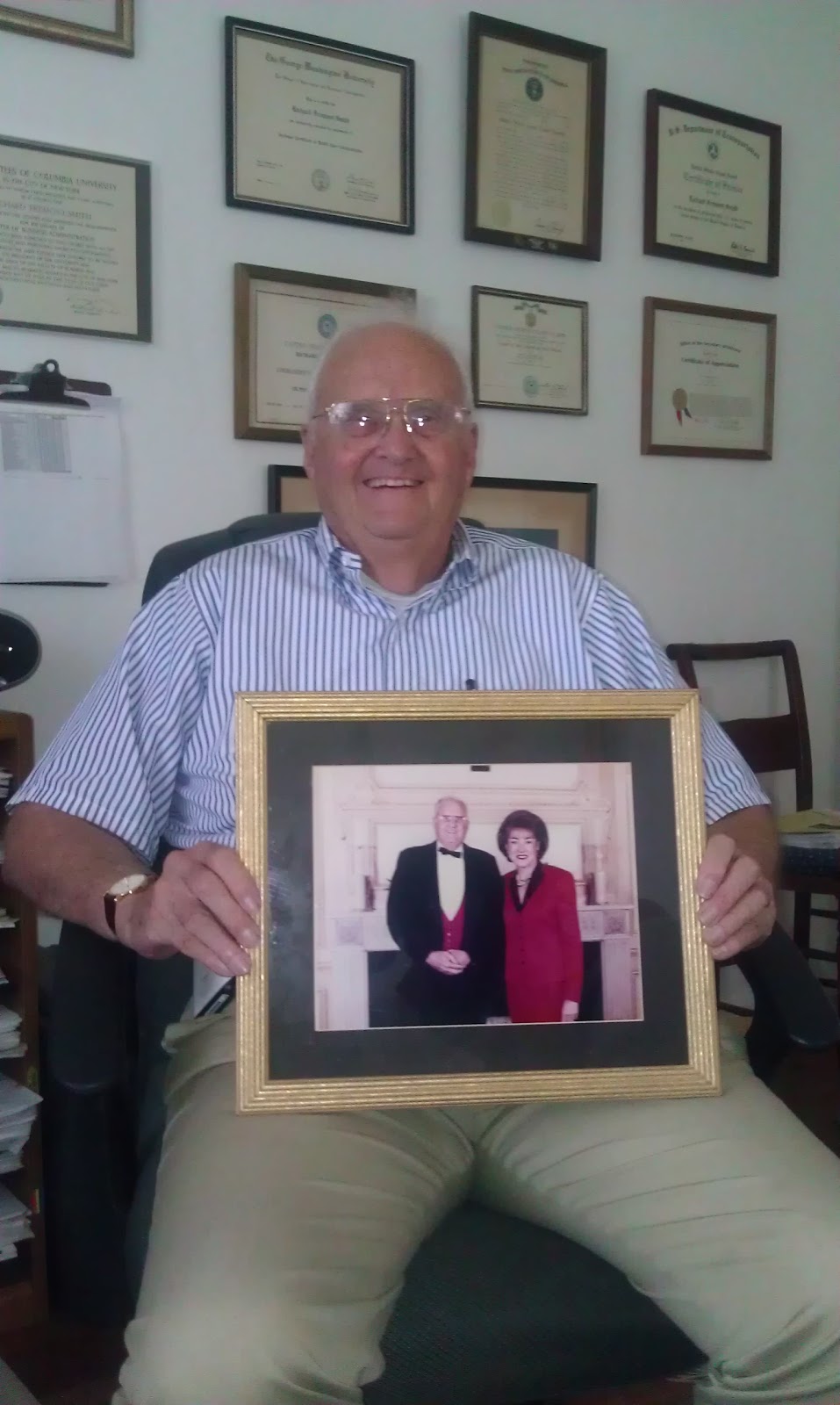
Richard Fremont-Smith is a Red Crosser all the way

U.S. Coast Guard Capt. (ret.) Richard Fremont-Smith,
a life-long Red Cross volunteer, poses in his home
office holding a picture of him with former
Red Cross President Elizabeth Dole.
Unlike many retirees, 76 year old Richard Fremont-Smith isn’t shuffle-board playing, rocking-chair material. This retired Coast Guard captain still enjoys being active and loves his Fort Lauderdale waterfront house with the boat docked in back.

Fremont-Smith had a successful career as a Coast Guard officer, stockbroker and hospital administrator, but a significant point of pride is his 50-year commitment to the American Red Cross as a volunteer and benefactor.

Born in Boston, Fremont-Smith grew up a block away from the Greater Boston Chapter, American Red Cross. In 1952 at the age of 17, he took his first CPR/First Aid course and never looked back. Shortly after the CPR class, Fremont-Smith signed up for the Disaster Action Team – a group of highly trained volunteers who help people affected by house fires and other disasters. 

He soon found himself in the heart of such major events as the Worcester, Mass., tornado of 1953 – a rare New England tornado that killed more than 90 people – and hurricanes Donna, Carol and Edna in New England in the 1950s. In the midst of these devastating disasters, Fremont-Smith and the Red Cross took care of those in need.

“We provided the victims with food, drink, shelter and emotional support,” said Fremont-Smith. “I remember being 17 and 18 and driving the disaster truck to remote areas to distribute good food, hot coffee and other assistance.”

During the summer of his sophomore year at Harvard, 19 year-old Fremont-Smith donned the Red Cross vest again, but this time as the Greater Boston Red Cross interim disaster director. He supervised the DAT members and recalled the collision of the Italian ocean liner the SS Andrea Doria that happened during his internship: “Forty-six people were killed that day and many survivors were brought to Boston. We did our best give them the assistance they needed.”

He went on many fire and other emergency calls and helped those affected. “At the time there was really no other assistance available and the people were very appreciative,” he said. “I may have spent more time with the Red Cross than I did studying.”

In 1956, after completing his sophomore year, Fremont-Smith enlisted in the U.S. Coast Guard. During his initial 10-year career with the Coast Guard, then Lieutenant Fremont-Smith traveled the world and was stationed in the Philippines and in Vietnam in 1965-1966 during the war.

In 1966, after a year of Vietnam combat duty, Fremont-Smith left the Coast Guard, went to Columbia University and got his MBA degree. After a brief stint as a stockbroker, he pursued his new interest in hospital administration. He also reconnected with the Red Cross and served on the board of directors of the Greater Boston Chapter.

He had remained in the Coast Guard Reserve, and in 1982, the Coast Guard called him back as a Captain to serve on a special assignment in Washington, D.C.  What was slated to be a four-month project turned into a 12-year assignment, eight years of it at the Pentagon.  But the Red Cross was never too far behind.  In 1989 Hurricane Hugo ravaged the Virgin Islands and the Red Cross disaster relief operation needed Fremont-Smith’s help. The Coast Guard and the Pentagon granted Fremont-Smith a six-week leave to serve as Red Cross Government Liaison Officer at St. Croix, USVI.

“We were feeding and sheltering 20,000 people. As government liaison, I coordinated everything between the Red Cross, government officials and local emergency agencies,” explained Fremont-Smith. “It was extremely active, busy and exciting.”

In 1994, Fremont-Smith retired from the Coast Guard and moved to Fort Lauderdale. But again, the Red Cross was never too far behind. He soon became involved with the local Red Cross chapter and served as a government liaison officer and mass care volunteer, and later as a member of the board.

“Throughout my career, I’ve always been interested in emergency work and public safety,” said Fremont-Smith. “I keep returning to the Red Cross because it does a great job in providing relief for people who have been affected by disaster. I enjoy being around to help others. I am very empathetic of the victims of disaster.”

The son of a renowned Boston physician father, and a highly acclaimed tennis player and author mother, Fremont-Smith comes from a lineage of helping others. After WWI, his father, Maurice Fremont-Smith, M.D., volunteered with the Near East Relief and the Red Cross in Turkey helping survivors of the war.

Over the span of 50 years, Dick volunteered in over 100 disaster relief operations across the country and U.S. territories and touched the lives of tens of thousands of people.

When Fremont-Smith listed some of the disaster relief operations he participated in, he sounded like a disaster field operations manual: “Wildfires in California, tornadoes in Oklahoma, an airplane collision outside Los Angeles, hurricanes, floods  and the Value Jet airplane crash in the South Florida everglades” just to name a few.

For years, Fremont-Smith gave generously of his time and talent, but he was also generous with his treasure. When asked for one of his fondest Red Cross moments he recalls his meeting with then American Red Cross President Elizabeth Dole in 1987. Fremont-Smith had donated $25,000 to the Broward County Chapter and was invited, along with other donors, to Washington, D.C. for a meet-and-greet and dinner with Dole. “I had a wonderful time and Mrs. Dole was lovely.”

Fremont-Smith no longer goes out on fire calls or to disaster stricken areas, but he remains involved and has taken steps to ensure that the Red Cross can continue its humanitarian mission after his volunteer days are over.

“I decided to include the American Red Cross in my estate plan through a bequest. The concept of neighbors helping neighbors is an old one, but one that truly works as Red Cross volunteers and employees across the country can attest,” explained Fremont-Smith. “I respect the Red Cross and it’s important to me that they have the financial resources needed to continue doing the good work they do everyday,” stated Fremont-Smith.

For more information on including the American Red Cross in your estate plan please call Gloria Kaplan, Sr. Gift Planning Officer at 1-800-759-2050 or email kaplang@usa.redcross.org. Contributions to the American Red Cross, a tax-exempt organization under section 501 (c) 3 of the Internal Revenue Code, are tax deductible. Federal Tax ID # 53-0196605.
Wednesday, April 20, 2011

The Red Cross is a blessing for this family

Gilda Brisbon and her family know what it’s like to be homeless, but when they moved into their home in the King Charles Road neighborhood in Raleigh, North Carolina three years ago they thought that those days were behind them.  However, on Saturday, April 16, everything changed when their home was destroyed by a class EF1  tornado and they lost everything but the clothes on their backs.

“My daughter Brittany was home alone when it hit,” said Brisbon.  “I had heard the warning sirens and was hurrying to get home.  I looked at my watch and it was 3:31pm when I saw the black funnel cloud coming right at me.”  She took refuge in a nearby friend’s house with her grandson Anthony, struggling to keep the door closed against the storm.

Daughter Brittany saw the lights flicker on and off, felt the house shake and heard the sounds of the storm and a large tree in their yard being uprooted.  She took refuge in the laundry room, fortunately suffering only minor cuts and bruises as the tornado demolished all but the kitchen and the laundry room.  “It rained very hard for about five or ten minutes, and then everything got quiet,” she said.  “I ran from the house to find my mother, and had to climb under and over many trees that were knocked down.”  She added “the houses on either side of ours were untouched, but ours was destroyed!  That’s just not fair!”

Tornado damage at Creekside Mobile Home Park in North Carolina
Tornado damage in Raleigh, NC
American Red Cross Emergency Response Vehicles are stocked with supplies.


You can help families like the Brisbons who have been affected by disaster. Click below to donate to the American Red Cross today.


The Brisbon’s stayed Saturday night and Sunday at the nearby house of their friend, Latesha Winston and her two children.  The power was out in the entire neighborhood, however, so when they heard that there was an American Red Cross shelter open at the Garner United Methodist Church in Garner, NC, they all took refuge there.

Red Cross Shelter Manager Judy Cox said that many of the families staying at the shelter have similar stories.  They have lost power, some have had their homes destroyed, and all are extremely grateful for the Red Cross help in their time of trial.

“This is the first time that we have ever stayed at a Red Cross shelter, but we know about homeless shelters from the 93 days we were without a place to call home,” Brisbon said.  “Your shelter here is so much nicer than that other place where we stayed, and all of your people are so kind to us and treat us wonderfully.  The Red Cross is really a blessing, and we thank you from the bottom of our hearts.”

Brisbon and her family are not sure what they will do next.  Their home has been condemned and they must now find a new place to live, but they have been through tough times before and are positive that they will make it through this challenge that life has thrown at them.


Story by Allen Crabtree, an American Red Cross volunteer in Raleigh, North Carolina

Thursday, April 7, 2011

Lemonade For a Good Cause


When 7-year-old Sarah Budnick watched the “60 Minutes” special on the Japanese earthquake and tsunami in mid-March, she knew she had to help and knew what to do.  The Coral Park Elementary first grader decided to set up a lemonade stand.

This isn’t the first time Sarah has showed her knack for capitalism and compassion. Last year she set up her lemonade stand to help the Haitians affected by the January 12, 2010 earthquake and donated to Doctors Without Borders. This time she wanted to help the Japanese devastated by the earthquake and tsunami last March and decided to raise funds for the Red Cross.

Sarah promoted her lemonade stand with signs and set up shop on March 20 along Riverside Drive in Coral Springs. Sarah raised $164 for the Red Cross.

On April 6, Michelle Tuggle, major gifts officer for American Red Cross South Florida Region went to Sarah’s school and presented her with a certificate of recognition in front of her classmates and school’s principal.

On behalf of the American Red Cross, thank you, Sarah, for all that you do!

So it's the NextGen...what's in it for me?

So, the Red Cross has been promoting it’s “Next Generation of Red Cross Training” over the last few weeks.  All of you have seen numerous posts from the Red Cross and from me on Twitter, Facebook, email and others about joining the Next Generation, but for you - our customer - to really understand the benfits requires a little more than a simple website story or a Twitter feed.  Wtih that in mind, I am here to educate everyone on some of the benefits for our customer in the new Red Cross training program.  So let’s get started.

Choices, Choices and More Choices


The single greatest thing about the new program is that you now have choices - and lots of them.  In the past, the Red Cross mandated that you purchase books, DVDs, skill cards and other teaching material for EVERY student in your classroom.  Those days are long gone, and now you have the power to decide exactly which materials - if any - you are going to purchase for your company, organization and participants.

The real question for a lot of our instructors boils down to what they can access digitally and what is available only for purchase.  Well, everything is available for download or purchase.  As a Red Cross instructor, you have access to everything you need to teach a class on http://www.instructorscorner.org.  The new version of Instructor’s Corner gives you access to everything digitally - from the DVD to the instructor manual to the participant material.  I don’t know about you, but I like have choices.  I like knowing that I can decide what is better in a printed format when purchased from the Red Cross or what I prefer to use in a digital format.  Now that truly is next generation!

Translating the Value:  Digital or Print?

Even at the Red Cross, I am using the free digital materials more than anything else. 
Just like, we want to keep our costs down to a minimum.  As a result, we print the ready reference cards for the exact number of students in a class.  To provide a strong learning experience, I have given a set of 10 published sets of the Adult Ready Reference and the Pediatric Ready Reference to my instructors.  The benefit for the instructor is that they have a resource they can use as a teaching tool.  The student is able to use the laminate version of the Ready Reference in the classroom while also receiving a digital copy of the material via email.  It is a great way to provide our students with a great learning experience while keeping our costs down to a minimum.

Just like you, the participants in our community classes have a choice.  They can decide to use the digital version of the material received via email, or they can purchase the laminate version of the Ready Reference card.  Some of our customers choose to purchase and others choose to use the free material.  Bottom line is that it doesn’t matter which one they choose.  Each person is learning a great skill from the Red Cross and getting the informaiton they need in our classes.

You can also use the digital material in the same fashion.  Need to provide durable teaching aids to your instructors?  Purchase a classroom set of material that meets the need of your business.  Need to provide students access to the reference material easily?  Send the link to the participant material found at http://www.redcross.org/trainingAs I said in the beginning, it is all about choices and flexibility.

I encourage all of you to spend some time getting to know the new Instructor’s Corner and exploring the many different choices available from the Red Cross.  Need help making a decision for your organization?  Call us at 305-644-1200 or 954-797-3800. You can also e-mail us at SouthFloridaPrepares@usa.redcross.org.

Hunter Ruffin
Sr. Director, Preparedness, Health & Safety
American Red Cross South Florida Region

You can follow Hunter Ruffin @CHRuffin and read his blog, RuffinIt, at http://ruffinit.tumblr.com/

Wednesday, April 6, 2011

The Red Cross Is Part of Life in the McNally Family

When Marie Lina McNally, her sons Wilfrid and Georges, and her brother Pierre Louise Pierre-Toussaint, immigrated to the United States four years ago they knew about the global Red Cross network.


In their hometown of Port-Au-Prince, they had seen the Haitian Red Cross in action many times—setting up shelters after a disaster, collecting blood, providing ambulance service, teaching personal hygiene to school children, and more.

Now in the United States, Marie Lina heard about American Red Cross services and programs. She listened intently when people talked about the Red Cross, because she is passionate about helping others. “Mom has always been honored to help people,” says her son Wilfrid.

Volunteering through AmeriCorps

Initially, Marie Lina, followed by Pierre, Georges and Wilfrid, volunteered at the Miami Red Cross chapter as part of the AmeriCorps State and National program. Under the program, nonprofit organizations such as the Red Cross receive grants to recruit, train and place AmeriCorps members in positions that meet critical community needs.

For a year, the four worked as members of the American Red Cross South Florida Region disaster action team, bringing food, shelter, comfort and hope to dozens of Miami residents day or night. They also taught community first aid classes, and participated in the recruitment and training of chapter volunteers.

Staying on as Red Cross Volunteers

As the year 2010 approached, Pierre signed up for a second season with AmeriCorps. Wilfrid, Georges and Marie Lina left the AmeriCorps program but continued with the Red Cross as active volunteers.

Then, on January 12, a 7.0 magnitude earthquake brought disaster to millions of Haitians. The quake deeply impacted the city of Miami, a city in which the first language of more than five percent of its population is Creole.

The American Red Cross South Florida Region sprang into action. Red Cross Call Centers were activated to help people locate family and friends. Red Cross teams welcomed Haitian evacuees at Miami’s airports, providing food, toothbrushes, diapers and hugs to people who had lost everything except the clothes on their backs.

It took a lot of volunteers to help the thousands of people who called the Miami chapter of the Red Cross after the earthquake, and many volunteers to assist the stream of Haitian evacuees arriving in the United States through Miami’s airports.
Among those volunteers were Pierre, Marie Lina, Georges and Wilfrid—answering telephones, acting as translators and receiving deplaning Haitians. The Red Cross opened around-the-clock shelters for incoming Haitians, locations at which Marie Lina spent several nights as a shelter volunteer.

Service on the USNS Comfort

During one of his college classes, Wilfrid received a text message from the Miami Red Cross saying that the chapter needed to talk to him because something big had happened in his home town in Haiti.
“They told me about the magnitude of the earthquake, the enormity of the damages and asked if we could provide assistance,” he remembers. “The Red Cross didn’t even have to ask—me and my family were ready to help.”

The Red Cross assigned Wilfrid as a translator on the USNS Comfort, a Navy hospital ship. He was trained and was on the Comfort headed for Haiti less than a week after the earthquake. For the next three weeks he served not only as a translator, but also provided moral support and helped patients with their daily routines during the humanitarian relief effort that brought medical treatment to more than 1,000 Haitians.

Wilfrid talks about a young Haitian whose face had been mutilated and who had lost both arms and a leg. The young man cried constantly, calling for a father who was not there. Wilfrid put the patient on a cart and asked permission to take him to the top deck.

Asking the patient for his dad’s phone number, Wilfrid dialed. “I have your son with me,” he said to the voice that answered his call. “What, my son is alive?” came a shout. After much crying, Wilfrid was able to get the dad to the closest port, where a Navy helicopter airlifted him to the Comfort to visit his son.

“It was a great reunion,” the Red Cross volunteer comments.

Wilfrid laughs about using his cell phone as a mobile call center. Many of the ship’s patients wanted to talk to members of their families, so Wilfrid activated his phone’s roaming services to connect families. Then the bill came, for close to $2,000.

But he doesn’t laugh about feeling the quakes’ after-shocks from the ship. Or about the 12-14 hour days and not being able to have a peaceful night’s sleep throughout the deployment.

In Wilfrid’s words, the time came when his three-week rotation was ended and he “had to leave.” When he came home he again joined his mother, brother and uncle, providing support as a Red Cross volunteer.

“The Red Cross has become a part of our lives,” he says, “It’s our way of helping people, of giving back to our community.”

Friday, March 18, 2011

Japan: earthquake, tsunami, nuclear warnings and now...snow

Below is a first person account from Nan Buzard, senior director of international response and programs with the American Red Cross, shared via email yesterday – three days into her week-long mission in Japan following the March 11 earthquake and tsunami. She is serving with a seven-person international team designed to support and advise the Japanese Red Cross, which continues to assist the government in its response.
 
(Today we visited) Otsuchi – a northern seaside town of 17,500 nestled between a large bay and forested hills. Now with thousands missing, 242 confirmed dead and over 6,700 evacuated. The mayor and many of the local civil servants were lost, and we spoke with Hiarno Koso, the deputy town administrator.


He was doing a heroic job but was clearly overwhelmed by the scale of the disaster, repeating that for all their tsunami planning they never imagined something of this scale – with a wall of water racing past the tsunami evacuation signs that were thought to be sufficient.

We saw two of the six established (evacuation) centers, both in public schools. One was perched on a hill with sweeping views across a now empty flooded expanse littered with smashed houses – and beyond that a bay still full of flotsam. We walked up streets with homes untouched on one side and gutted on the other. That is how it is everywhere – a line where the wave reached and then it stopped.

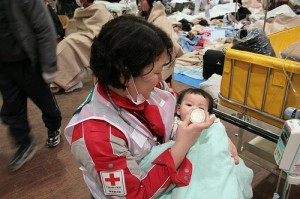
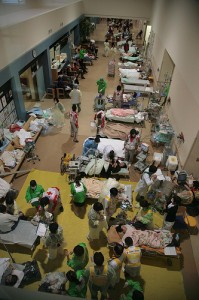
The centers are cold with hundreds gathered in the gymnasium, a small kerosene heater no match against the big room. Many of the evacuees we saw were elderly and you could see the shock and exhaustion on their faces. The first few days people had one rice ball a day, then two and now, on the 6th day, are eating three meals a day. But without fuel and stoves there is no heat, and I hate to think how miserable it will be when night comes. No electricity means no water though there were some buckets for minimal washing.

There are some doctors and nurses from the town as well as some Japanese Red Cross mobile clinics but medicines for chronic disease are running out. But people receive our visit with enormous graciousness. 
 
 
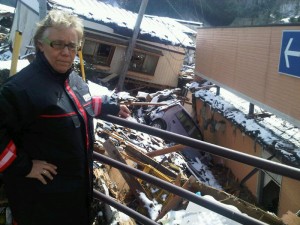
The scale of the damage is staggering. Cars are perched in trees and bent against bridge railings as if with a broken back. Boats are tossed across roads and a huge freighter is thrown halfway onto land. Apartment buildings miles inland have fourth floor windows swept away. Twisted metal beams and huge piles of splintered wood are everywhere. The air smells of dead fish and probably dead bodies, and the stink of the fires from the floating infernos – which scorched the hills – has permeated our clothes. 
 
 
There is no question that the enormity of the situation would challenge any government. Hundreds of towns and villages are destroyed and thousands upon thousands of people have lost homes.

Koso did not know what would become of all those in his care. For sure the schools would postpone opening on April 6 but the gymnasiums are not tenable for the months and years it will take to rebuild. Where they will live while the enormous task of rebuilding takes place was beyond his imagination – and he was not sure how many would want to stay anyway in the place that had seemed so safe and was now so full of loss and grief.

And as we left snow began to fall on the silent town. (We’re) now in the car on the way back to Tokyo, and we are once again talking about the failed nuclear reactor. Apparently in addition to the contaminated houses, the farmland is too – so many additional lives and livelihoods are affected by this earthquake.

Nan and the rest of the international advisory group will continue to update us as they can. To learn more about the Japanese Red Cross response and the people being helped, visit our Disaster Online Newsroom.

Tuesday, March 8, 2011

March is Red Cross Month

March is Red Cross Month and the American Red Cross is asking South Florida to join us in providing help and hope to people in need.

The Red Cross works tirelessly to help those who need assistance, whether down the street, across the country, or around the world. For 130 years Red Cross has been at the forefront to respond to disasters, help members of the military and teach lifesaving skills.

Currently the Red Cross responds to an average of nearly 200 disasters every day. Last year your local American Red Cross responded and provided assistance in 530 local disasters, processed 1,840 emergency military calls and conducted over 15,000 first aid and water safety classes.

The Red Cross is not a government agency and relies on donations of time and money to do its work. Sign up today for a CPR/first aid or other Red Cross course; give a financial gift that can save the day when the next disaster strikes, or get involved as a volunteer. For more information, visit www.southfloridaredcross.org.

For those who already support the American Red Cross and the work that we do, thank you. For those of you waiting to make a difference in someone’s life, wait no more. Join the American Red Cross today.

Sincerely,
Sam Tidwell
Chief Executive Officer 
American Red Cross South Florida Region

PS - If you're on Twitter, follow us @SFLRedCross and use the following hashtag to stay up to date on the latest news for #RedCrossMonth.

Monday, December 20, 2010

This year, your gifts can save the day

Christmas is almost here. Have you got your gifts ready?

The holiday season reminds us to reflect upon the many gifts we received throughout the year, but also to remember those in need around us. We’ve launched this year’s Give Gifts that Save the Day holiday giving campaign, giving you the chance to make a difference in the life of someone in need.

Through our online catalog at SouthFloridaRedCross.org, or TuCruzRoja.org, you can make a donation that could help a soldier make an emergency call home; ensure a young child get the vaccine he needs to survive; or provide a month of basic necessities for a family in another country who lost everything in a disaster.

This is the perfect way to pay tribute to family members, friends or that certain someone who’s hard to buy for. Your loved one will receive a card acknowledging your gift in their honor.

We know that these are difficult times for many families and businesses in South Florida, but we also see that when Americans are in need, America always responds. We’re glad to find out that the results of our new national survey for the American Red Cross show that support for charitable giving remains strong with 72% planning to spend more or about the same in their donations to charity, even as 35% are tightening their belts on holiday gifts. The holiday season is traditionally a time of hope and generosity, and this campaign gives us all a chance to make a difference in someone’s life.

Merry Christmas and have a safe holiday season,
Sam Tidwell
CEO of the American Red Cross South Florida Region

March is Red Cross Month